Into the White: The Ultimate Guide to Snow Expeditions for Extreme Weather Lovers
The Psychology of the Extreme Cold Adventurer
What drives a person to spend thousands of dollars to sleep in a tent on an ice shelf where the temperature can drop to minus forty degrees? For many, it is the pursuit of absolute silence and the clarity that comes with extreme environmental pressure. In the deep cold, every movement must be intentional. Every piece of gear must be managed with precision. This level of focus creates a form of “forced mindfulness” that is nearly impossible to achieve in the cluttered, noisy environment of modern daily life. There is also the aesthetic appeal of the “white-out”—a world stripped of color and reduced to the fundamental elements of light, shadow, and texture.
Premier Destinations for Arctic and Antarctic Expeditions
The poles represent the gold standard for snow expeditions. These regions offer a sense of isolation that is truly unique on Earth.
-
Antarctica: An expedition to the South Pole or the Vinson Massif is the pinnacle of cold-weather adventure. Travelers often fly into base camps via specialized cargo planes before embarking on cross-country ski treks or climbing expeditions. The continent is characterized by “katabatic winds”—fierce, gravity-driven gusts that can reach hurricane speeds, creating dramatic snow drifts and challenging visibility.
-
Svalbard, Norway: Located halfway between mainland Norway and the North Pole, Svalbard is one of the northernmost inhabited places on the planet. Expeditions here often involve multi-day dog sledding or snowmobile treks through the wilderness. It is a prime location for observing polar bears in their natural habitat and experiencing the ethereal glow of the Aurora Borealis during the polar night.
-
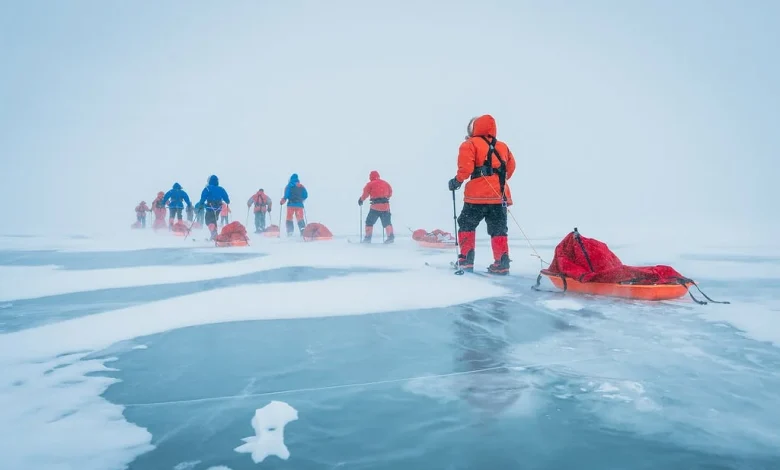
Greenland: The Greenland Ice Sheet is the second-largest body of ice in the world. Crossing the ice cap is an elite endurance feat that takes weeks. Expeditioners pull “pulks”—heavy sleds containing all their food, fuel, and shelter—across a landscape that looks more like a different planet than part of the Earth.
High-Altitude Challenges: The Vertical Winter
While the poles offer horizontal vastness, the great mountain ranges of the world provide the challenge of verticality combined with extreme cold.
The Himalayas and Karakoram
Climbing in these ranges during the winter months or early spring is reserved for the most experienced mountaineers. The combination of thin air and extreme cold creates a double-threat to human physiology. Winter expeditions to peaks like K2 or Nanga Parbat are historically significant events, often requiring months of preparation to navigate the “Savage Mountain” in its most brutal state.
The Alaskan Range
Denali, the highest peak in North America, is famous for its extreme weather. Because of its high latitude, the barometric pressure is lower than at the equator, making the air feel even thinner than its 20,310-foot elevation suggests. Expeditions here are self-supported, meaning climbers must ferry hundreds of pounds of gear up the mountain themselves, often battling storms that can last for a week at a time.
Essential Gear for Survival and Success
In extreme cold, gear is life. The philosophy of “layering” is the cornerstone of snow expeditions, but the materials used are far more advanced than a standard winter coat.
-
Base Layers: Modern expeditions rely on merino wool or advanced synthetics that wick moisture away from the skin. If sweat freezes against the body, hypothermia becomes an immediate risk.
-
Insulation: High-fill power down is the preferred insulator for dry, extreme cold because of its incredible warmth-to-weight ratio. For damper conditions, synthetic insulators that maintain loft when wet are essential.
-
The Outer Shell: A hardshell layer must be completely windproof and waterproof while still allowing some moisture vapor to escape. In high-wind environments, “ruffs” made of real or synthetic fur are used on hoods to create a pocket of still air around the face, preventing frostbite.
-
Footwear: Triple-layered boots with integrated gaiters and thick insulation are standard for high-altitude or polar treks. These boots are designed to be used with crampons for traction on blue ice or steep snow slopes.
Technical Skills and Training
No one should embark on an extreme snow expedition without significant prior training. Most professional guide services require participants to complete several prerequisite courses.
Glacier Travel and Crevasse Rescue
Moving across a glacier is inherently dangerous due to hidden cracks in the ice called crevasses. Expedition members must be “roped up” to one another. Training involves learning how to use pulleys and mechanical advantage systems to haul a teammate out of a crevasse if they fall through a snow bridge.
Winter Camping and Stove Maintenance
Surviving the night requires more than just a good sleeping bag. It involves knowing how to build snow walls to shield a tent from the wind and how to use a multi-fuel stove at high altitudes. In frozen environments, melting snow for water is a constant, time-consuming necessity. If your stove fails, you have no water, and your expedition is over.
The Ethics of Cold-Weather Tourism
As these remote areas become more accessible through specialized tourism agencies, the environmental impact has come under scrutiny. The “Leave No Trace” principles are particularly difficult to follow in frozen environments where waste does not decompose. Responsible expedition companies now require all human waste and trash to be packed out of the wilderness. Additionally, there is a focus on minimizing the carbon footprint of the flights required to reach these fragile ecosystems.
Conclusion
Snow expeditions for extreme weather lovers represent a marriage of high technology and primal survival. Whether it is the vast, flat expanse of the Antarctic plateau or the jagged, wind-scoured ridges of the Andes, these environments offer a perspective on the world that cannot be found anywhere else. They remind us of our own fragility and the incredible resilience of the human spirit. For those who choose to venture into the white, the reward is a memory of a landscape so pure and powerful that it changes one’s perception of the Earth forever.
Frequently Asked Questions
How do expeditioners keep their electronics functioning in sub-zero temperatures?
Batteries lose their charge rapidly in the cold. Professionals keep batteries for cameras and GPS units inside their clothing, close to their body heat, when not in use. Some also use specialized insulated battery cases or solar panels that are designed to function in low-temperature, high-UV environments.
What is the caloric intake requirement for a person on a polar expedition?
In extreme cold, the body burns a massive amount of energy just to maintain its internal temperature. A person pulling a sled in the Arctic may need between 5,000 and 7,000 calories per day. Diet typically consists of high-fat foods like nuts, chocolate, butter, and dehydrated meals that can be easily prepared with melted snow.
How do you prevent frostbite on the face when winds are high?
Beyond using a fur ruff on a hood, expeditioners use face masks and specialized goggles that leave no skin exposed. Applying “dermatone” or similar protective balms can provide a thin barrier, but the most effective method is the “buddy system,” where teammates constantly check each other’s faces for the white patches that signal the onset of frostbite.
Is it possible to shower or maintain hygiene on a multi-week snow trek?
Traditional bathing is impossible. Most expeditioners rely on “dry showers” using specialized wet wipes. Hygiene is focused on the feet and “friction zones” to prevent sores or infections that could end an expedition. Most people simply accept that they will be dirty until they return to base camp.
What kind of mental preparation is required for these trips?
Mental resilience is often more important than physical strength. Expeditioners must be prepared for “tent days” where they are trapped in a small nylon shelter for 48 hours or more during a storm. Developing coping mechanisms for boredom, isolation, and physical discomfort is a key part of training.
How do expeditions handle medical emergencies in such remote locations?
Most large expeditions have a designated medical officer or a guide trained in Wilderness First Aid. For serious injuries, satellite phones are used to coordinate a “medevac” (medical evacuation) by helicopter or plane, though these rescues are entirely dependent on weather conditions and can be delayed for days.
Do you need to be a professional athlete to go on a snow expedition?
While you don’t need to be a professional athlete, you must be in peak physical condition. Many participants spend six months to a year training by hiking with weighted packs, stair climbing, and performing strength training. A high level of cardiovascular endurance is non-negotiable.